Blog 1: Journey into Embodiment
Why Embodied Voice?
6/15/20252 min read
Why Embodied Voice?
Introduction
Welcome to my research journey.
I am currently undertaking a Master's in Dance Research for Professional Practitioners, where I am exploring the following question:
How can embodied voice practices support presence, expression and authenticity in female dancers?
As a dance artist, yoga teacher, researcher and certified embodiment coach, I have always been fascinated by the relationship between movement, breath, voice and human experience. Over the years, my practice has expanded beyond choreography to include meditation, somatic practices and embodied movement. These experiences have led me to ask how voice and movement can work together to support dancers in feeling more present, expressive and connected to themselves.
Rather than viewing voice simply as something we use to speak or sing, this research explores voice as an embodied practice. Breath, sound and movement become tools for awareness, creativity and expression.
Throughout this blog series, I will share my studio practice, reflections and theoretical ideas as they develop through Practice-as-Research. Instead of separating theory from practice, I explore knowledge through movement, experimentation and reflection.
Studio Reflection
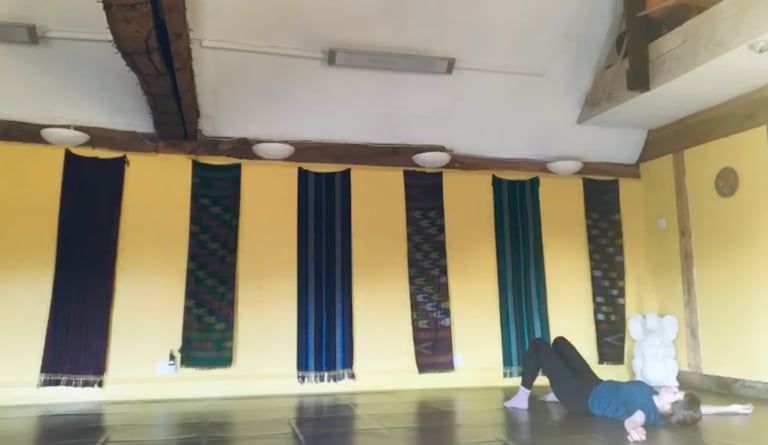
I began my research by slowing everything down...
tuning into the body...
simply listening to what was already there...
Any emotions...
exhaustion...
or stories my body might be holding...
Giving myself permission to simply be...
to listen...
and to hear...
I focused on my breath...
feeling how it travelled through my body...
This made me question what stillness really means...
Are we ever truly still...?
Even when standing quietly...
my belly continued to rise and fall with each breath...
Before any movement...
before any sound...
there is always breath...
Before moving, I stood in silence and observed my breathing...
I noticed tension across my shoulders and jaw before I had even started dancing...
This reminded me that awareness often begins before movement itself...
These observations led me to ask:
What changes when breath leads movement?
For me, the focus shifted inward. Instead of concentrating on technique, I became more present in my body. The breath became the leader, allowing movement to emerge more naturally rather than trying to control it.
How does voice influence presence?
As I began introducing sound, I noticed my mind wanted to analyse and organise the experience rather than simply feel it. At times it seemed to avoid emotions connected to certain parts of my body, choosing familiarity instead. This became an important reminder that embodied practice asks us to notice these responses rather than judge them.
What can the body teach us when we take time to listen?
This became one of the most important questions for me. Each time I paused, listened and returned to movement, I discovered something new. Creating a balance between listening, sounding and moving opened new possibilities for exploration and helped me feel more connected to my body and my creative process.
Reference list:
Barbour, K. (2004) 'Embodied ways of knowing', Waikato Journal of Education, 10, pp. 227–238.
Clark, B. (2019) The Complete Guide to Yin Yoga: The Philosophy and Practice of Yin Yoga. 2nd edn. White Cloud Press.
Feldenkrais, M. (1972) Awareness Through Movement. New York: Harper & Row.
Goodchild, C. (2003) The Naked Voice. London: Jessica Kingsley Publishers.